Quick start
- Enter the mass number from your scale, problem, label, or supplier note.
- Enter the matching volume number, such as mL, cm3, m3, L, or ft3.
- Type the density unit label you want beside the result, such as g/mL, g/cm3, kg/m3, or lb/ft3.
- Check that the mass and volume units behind the numbers actually match that label.
- Press Calculate density and read the ratio, formula line, and examples together.
Best uses
Use this guide when you already measured mass and volume and need a quick density result you can explain.
- Find density from a measured mass and volume.
- Check a classroom density formula.
- Label results in g/mL, kg/m3, lb/ft3, or another unit.
- Compare water-like, metal-like, box, and bulk material examples.
What this calculator is solving
The Density Calculator is a direct formula helper for science, materials, classroom examples, liquid checks, and bulk-volume estimates where mass and volume are known.
Match each input label on the calculator to the measured mass, measured volume, and density unit label you want to read, such as grams with milliliters for g/mL or kilograms with cubic meters for kg/m3.
The formula in plain language
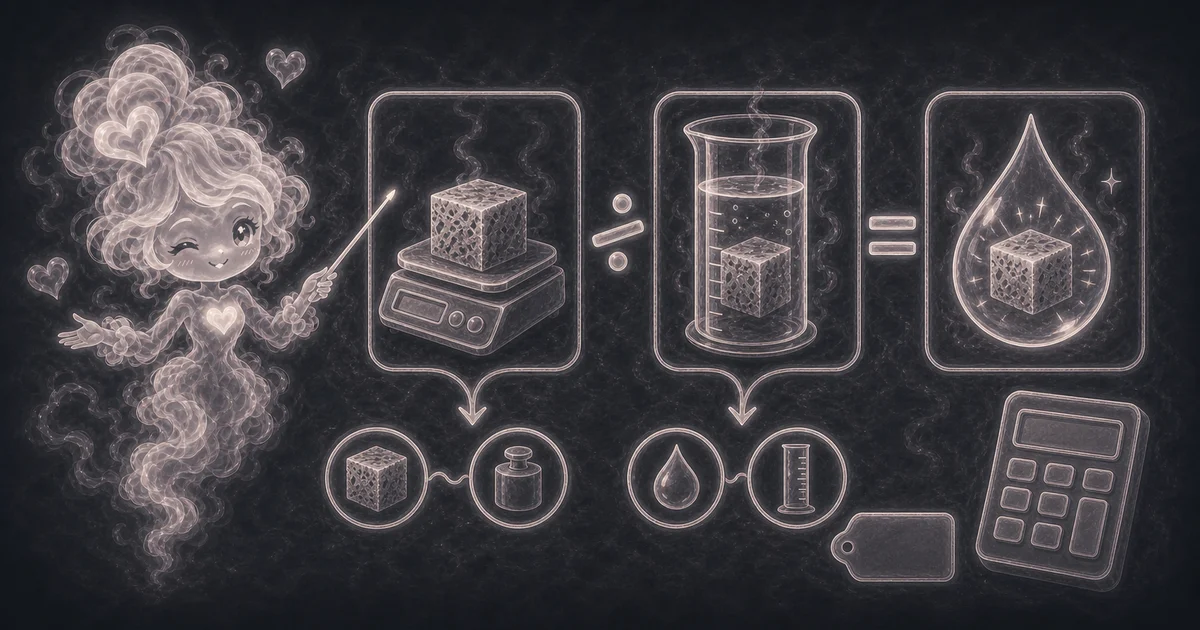
In plain language: The calculator uses density = mass / volume. It divides the mass number by the volume number and prints the unit label you entered, so the label should match the units behind the inputs. The examples on the page are there so you can compare your inputs with a worked example before copying the answer.
The calculator does not convert the label for you. It divides the two numbers and prints the label you typed, so the unit work has to be right before you press calculate.
How to read the answer
Read density as a ratio: how much mass fits into one unit of volume. Then check the repeated mass, volume, and formula line so you can catch a copied value or unit-label mistake before you use the answer.
- Density is the main answer, such as 2.7 g/mL or 1600 kg/m3.
- Mass and volume are repeated so you can see exactly which numbers were divided.
- The formula line should match density = mass / volume.
- The unit label is only text, so it proves nothing unless the inputs were already in matching units.
- Use the quick examples to sanity-check whether your answer is water-like, metal-like, or bulk-material-like.
Common mistakes to avoid
If a density answer looks wildly high or low, pause before changing the material. The likely issue is a unit mismatch, a wrong volume, or a label that says one thing while the inputs mean another.
- Do not mix grams with cubic meters and label the answer g/mL.
- Do not type kg/m3 as the label unless the mass is in kilograms and the volume is in cubic meters.
- Do not assume the calculator converts g, kg, mL, cm3, m3, or ft3 inside the label box.
- Use calibrated measurements for lab, supplier, engineering, or safety work.
- Remember that temperature, moisture, packing, air gaps, impurities, and material condition can change real density.
Quick answer
Density is mass divided by volume. If a sample has 27 g of mass and takes up 10 mL of volume, the density is 27 / 10 = 2.7 g/mL.
The calculator is fastest when the units are already lined up. If the mass is in grams and the volume is in milliliters, label the answer g/mL. If the mass is in kilograms and the volume is in cubic meters, label the answer kg/m3.
What the inputs mean
Mass is how much matter is in the sample. For this calculator, it can be grams, kilograms, pounds, ounces, or another mass unit as long as you use a matching density label.
Volume is how much space the sample takes up. Common density examples use mL for liquids, cm3 for small solid samples, m3 for bulk material, and ft3 for some construction or shipping notes.
Unit label is the text printed beside the answer. It helps your notes make sense, but it is not a hidden unit converter.
Example: lab sample in g/mL
Say a small sample has mass 27 g and volume 10 mL. Enter 27 for mass, 10 for volume, and g/mL as the unit label.
The calculator returns 2.7 g/mL because 27 / 10 = 2.7. That means each 1 mL of this sample has about 2.7 g of mass.
This is also a good unit check. If your volume was really 10 cm3, the same number could be written as 2.7 g/cm3 because 1 cm3 equals 1 mL.
Example: liquid close to water
A liquid with mass 997 g and volume 1000 mL has density 997 / 1000 = 0.997 g/mL.
That result is close to 1 g/mL, which is a useful sanity check for many water-like examples. It does not prove the liquid is pure water, but it tells you the answer is in the expected neighborhood.
Example: bulk material in kg/m3
For a bulk material, suppose mass is 1600 kg and volume is 1 m3. Enter 1600, 1, and kg/m3.
The result is 1600 kg/m3. This kind of density is common when you are checking a supplier value, a school problem, or a rough material estimate before using a more specific tool.
When you need a conversion first
If your mass and volume are not already paired, convert before using the density calculator. For example, kilograms with liters gives kg/L, while kilograms with cubic meters gives kg/m3.
Do not fix a unit mismatch by changing only the label. The label should describe the units behind the two numbers you actually divided.
When not to rely on this alone
Use this page as formula help, not as a lab certification or supplier guarantee. Real density can shift with temperature, moisture, air pockets, compaction, impurities, grade, and measurement precision.
For lab reports, engineering work, shipping limits, structural estimates, or material purchases, use calibrated measurements, the method your class or workplace requires, or the supplier data sheet before trusting a quick result.
Research and references
These references help check the measurements, units, limits, or safety notes used in this guide.
Worked examples for Density Calculator
2.7 g/mL
7.5 kg/m3
0.997 g/mL
2.7 g/cm3
1600 kg/m3
FAQ in plain language
When should I use the Density Calculator?
Use it when your task matches one of these common needs: Find density from a measured mass and volume. Check a classroom density formula. It works best when you already know the measurements, amounts, units, or options the page asks for.
What is the Density Calculator doing with my inputs?
In plain language: The calculator uses density = mass / volume. It divides the mass number by the volume number and prints the unit label you entered, so the label should match the units behind the inputs. The examples on the page are there so you can compare your inputs with a worked example before copying the answer.
What do the main Density Calculator inputs mean?
Mass: how much matter the sample has, such as grams, kilograms, pounds, or another mass unit. Volume: how much space the sample takes up, such as mL, L, cm3, m3, ft3, or another volume unit. Unit label: plain text for the answer, like g/mL, kg/m3, or lb/ft3. The calculator does not convert units inside that label.
How should I read the Density Calculator answer?
Read the headline answer, then check the supporting lines and examples to understand how the calculator got there. If one input changes, rerun the tool and compare the new answer instead of guessing.
What should I double-check before trusting the answer?
Use consistent units before calculating because the unit label is text only. Lab, engineering, supplier, and material decisions can require calibrated measurements, temperature control, moisture checks, and official standards. Also check the unit, scale, mode, and result limit because small input changes can change the answer.
Why do density units have to match?
Density is a ratio. If mass is in grams and volume is in milliliters, the answer is g/mL. If mass is in kilograms and volume is in cubic meters, the answer is kg/m3. Mixing units without converting first makes the label wrong even when the division is correct.
Does the unit label convert my answer?
No. The label is printed beside the answer so your notes make sense. Convert the mass and volume values first if you need a different density unit.
Related tools
- Mass CalculatorCalculate mass from density and volume with unit-matching reminders.
- Weight CalculatorCalculate physics weight force from mass and gravity in newtons and pounds-force.
- Conversion CalculatorConvert length, mass, volume, and temperature units with clear formula steps.
Keep exploring
If this guide is close but not exact, these links keep you near the same kind of problem.
- CalculatorsBrowse the full category for related tools that help with the same job.
- All free toolsSearch the complete Access Free Tools library by task, category, or tool name.
- All calculator and utility guidesFind more plain-language examples, formulas, mistakes, and result explanations.
- Free calculator resourcesStart here when you are not sure which calculator page fits.
Privacy and copying results
Recent answers stay visible only while you work in the current browser tab. They are not sent to a server.
Use Copy answer when you want to save the inputs and result in notes, homework, a message, or a project list. Check the units, labels, and limits before copying.