Quick start
- Open the GFR Calculator.
- Enter age in years, not birth year or age range.
- Use the first example, "Female 50: Creatinine 0.9 mg/dL", if you want to see a filled-out calculation before entering your own values.
- Calculate, read the formula line, then copy the result only after the units and assumptions look right.
Best uses
Start here if one of these sounds like your job. The examples below show which inputs matter most.
- Estimate adult eGFR from a creatinine lab value.
- Use the 2021 CKD-EPI race-free equation.
- See a broad eGFR interpretation range.
- Prepare questions for a clinician about kidney labs.
What this calculator is for
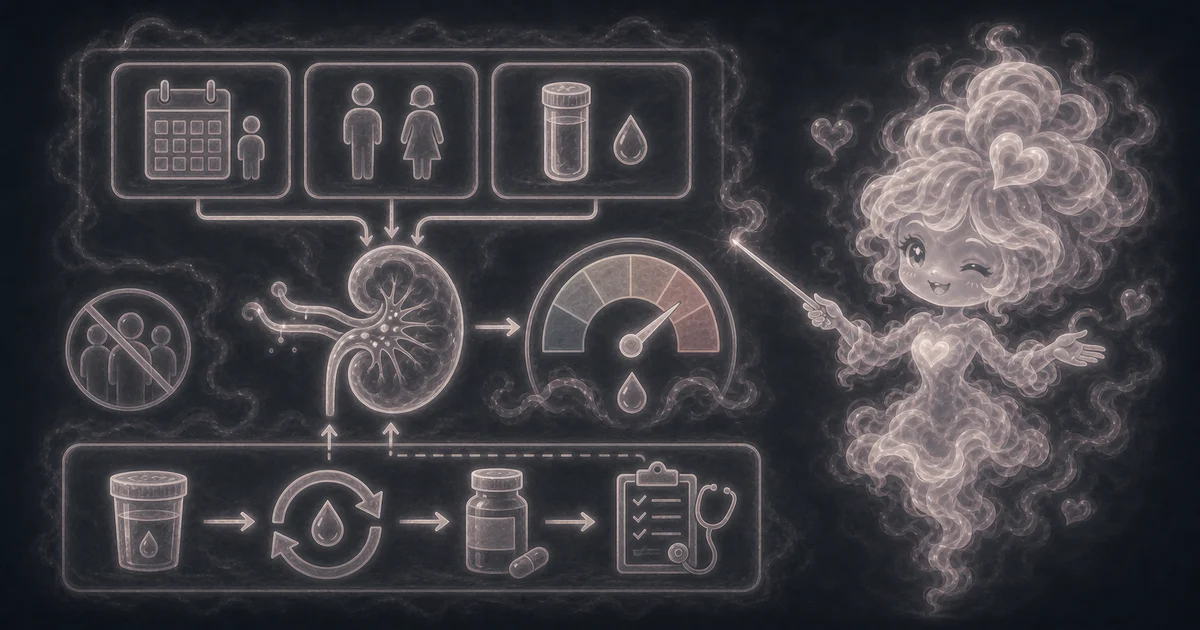
The GFR Calculator estimates adult eGFR from age, sex used by the equation, and standardized serum creatinine in mg/dL using the 2021 CKD-EPI creatinine equation. It is useful for understanding a lab number, not for diagnosing kidney disease or deciding treatment.
Use it when you want to: Estimate adult eGFR from a creatinine lab value. Use the 2021 CKD-EPI race-free equation.
What to enter
Good answers start with clean inputs. Before calculating, check the labels, units, and dates so the tool is solving the same problem you actually have.
- Enter age in years, not birth year or age range.
- Choose the sex used by the equation, because the 2021 CKD-EPI constants differ by sex.
- Enter standardized serum creatinine in mg/dL from a lab result. Do not type a micromoles-per-liter value, cystatin C, urine albumin, body weight, or an old creatinine result into that box.
Example walkthrough
Try the calculator example: Female 50: Creatinine 0.9 mg/dL. The example result is About 77.88 mL/min/1.73 m2.
- For a 50-year-old using the female equation with creatinine 0.9 mg/dL, the tool uses k = 0.7, alpha = -0.241, the 1.012 female multiplier, and age factor 0.9938^50. The result is about 77.88 mL/min/1.73 m2.
- For a 60-year-old using the male equation with creatinine 1.1 mg/dL, the tool uses k = 0.9, alpha = -0.302, no female multiplier, and age factor 0.9938^60. The result is about 76.85 mL/min/1.73 m2.
- For a 70-year-old using the female equation with creatinine 1.2 mg/dL, the estimate is about 48.7 mL/min/1.73 m2, which is a reason to check the real lab report with a clinician rather than self-diagnose from the calculator.
- No race coefficient is used in these examples.
Formula and steps
In plain language: eGFR = 142 x min(Scr/k, 1)^alpha x max(Scr/k, 1)^-1.200 x 0.9938^age x sex factor. Scr is standardized serum creatinine in mg/dL. For this calculator, k is 0.7 and alpha is -0.241 for the female equation, k is 0.9 and alpha is -0.302 for the male equation, and the female equation uses a 1.012 multiplier. No race coefficient is used. Read the result together with the notes on the page, because health and fitness numbers often need personal context.
Read the formula note when you need to understand where the number came from, especially before comparing results over time.
How to read the answer
eGFR depends on standardized lab creatinine and clinical context. A clinician may compare it with urine albumin, repeat labs, symptoms, medications, age, pregnancy status, body size, and health history.
- Read eGFR as an adult kidney-filtration estimate in mL/min/1.73 m2, not as an exact measured filtration test.
- One result does not diagnose chronic kidney disease. Clinicians often look for repeated low eGFR, urine albumin, symptoms, diabetes, blood pressure, medications, imaging, and acute-illness context.
- The estimate can be less reliable for children, pregnancy, transplant care, dialysis, acute kidney injury, very high or low muscle mass, amputation, severe illness, or medication-dosing decisions.
Common mistakes to avoid
Most bad results come from a small input mistake or from using a rough estimate for a decision it cannot safely answer.
- Do not enter creatinine in micromoles per liter unless the value has been converted to mg/dL by a reliable source.
- Do not compare an old lab from a different illness, lab method, or hydration state as if it were today's kidney function.
- Do not use the result to start, stop, or dose medication.
- Do not use this adult creatinine equation as a child, pregnancy, transplant, emergency, or dialysis decision tool.
- Do not ignore symptoms, abnormal urine tests, or clinician instructions because one calculator result looks reassuring.
What to try next
A related health tool can help check the same topic from another angle, but one number should not replace proper care.
- Bring the actual lab report, date, creatinine unit, eGFR line, and urine albumin result if available to a qualified clinician.
- Use Body Surface Area Calculator only as a separate educational reference.
- Use BMI Calculator or Healthy Weight Calculator only for separate adult weight-screening context, not kidney diagnosis.
Sources and safety notes
This guide uses public-health, clinical, or peer-reviewed references where the calculator needs a specific formula or interpretation boundary.
Source links are provided for transparency, but they do not turn the calculator into medical advice or a replacement for professional care.
Worked examples for GFR Calculator
About 77.88 mL/min/1.73 m2
About 76.85 mL/min/1.73 m2
About 48.7 mL/min/1.73 m2
About 63.17 mL/min/1.73 m2
FAQ in plain language
When should I use the GFR Calculator?
Use it for simple educational checks, trend tracking, or planning tasks like these: Estimate adult eGFR from a creatinine lab value. Use the 2021 CKD-EPI race-free equation. It can help you understand a number, but it cannot explain your whole health situation.
What do the main GFR Calculator inputs mean?
Enter age in years, sex used by the equation, and standardized serum creatinine in mg/dL from a lab result. Do not enter micromoles per liter, old lab values, cystatin C, urine albumin, or body weight in the creatinine box.
What is the GFR Calculator doing with my inputs?
In plain language: eGFR = 142 x min(Scr/k, 1)^alpha x max(Scr/k, 1)^-1.200 x 0.9938^age x sex factor. Scr is standardized serum creatinine in mg/dL. For this calculator, k is 0.7 and alpha is -0.241 for the female equation, k is 0.9 and alpha is -0.302 for the male equation, and the female equation uses a 1.012 multiplier. No race coefficient is used. Read the result together with the notes on the page, because health and fitness numbers often need personal context.
How should I read the GFR Calculator result?
Read eGFR as an adult kidney-filtration estimate in mL/min/1.73 m2. The range label is context only. Kidney disease, medication dosing, and next steps depend on repeat labs, urine albumin, symptoms, diagnosis, age, pregnancy status, body size, and clinician review.
What equation does this GFR calculator use?
It uses the 2021 CKD-EPI creatinine equation for adults. The inputs are age, sex used by the equation, and standardized serum creatinine in mg/dL. It does not use cystatin C, urine albumin, race, height, weight, or body surface area entered by the user.
Does this eGFR calculator use a race coefficient?
No. This page uses the 2021 CKD-EPI creatinine equation without a race coefficient, matching the current race-free formula structure published for adult creatinine-based eGFR reporting.
Why does serum creatinine need to be in mg/dL?
The equation on this page expects standardized serum creatinine in mg/dL. Some lab reports use micromoles per liter. Do not type a value from a different unit system unless the lab report or a clinician gives the mg/dL value.
Related tools
- Body Surface Area CalculatorEstimate adult body surface area with Mosteller and Du Bois formula results.
- BMI CalculatorEstimate adult body mass index and healthy BMI weight range.
- Healthy Weight CalculatorFind the adult BMI 18.5 to 24.9 weight range for a height.
Keep exploring
If this guide is close but not exact, these links keep you near the same kind of problem.
- Health & FitnessBrowse the full category for related tools that help with the same job.
- All free toolsSearch the complete Access Free Tools library by task, category, or tool name.
- All calculator and utility guidesFind more plain-language examples, formulas, mistakes, and result explanations.
- Free calculator resourcesStart here when you are not sure which calculator page fits.
Privacy and copying results
Recent answers stay visible only while you work in the current browser tab. They are not sent to a server.
Use Copy answer when you want to save the inputs and result in notes, homework, a message, or a project list. Check the units, labels, and limits before copying.