Quick answer
Start by choosing the job: Simplify, Equivalent, or Split total. Enter the numbers in the same order they appear in the real problem. Then check the steps before using the answer.
For example, 12:18 simplifies to 2:3. A 4:7 ratio scaled so the first part becomes 20 becomes 20:35. A total of 120 split by 2:3 gives shares of 48 and 72.
Pick the right mode
- Simplify: reduce 12:18, 1.5:2.25, or another ratio to lowest terms.
- Equivalent: scale a ratio when one new part is known, like 4:7 = 20:?.
- Split total: divide one amount by ratio parts, like 120 split by 2:3.
Simplify a ratio
Simplify mode reduces two-part or three-part ratios. The calculator divides every part by the same greatest common divisor, so the relationship stays the same.
For 12:18, the greatest common divisor is 6. Divide both parts by 6 and the answer is 2:3. For 1.5:2.25, the calculator clears decimals first, so it becomes 150:225, then simplifies to 2:3.
Scale an equivalent ratio
Equivalent ratios use the same multiplier on every part. If 4:7 becomes 20:?, the first part was multiplied by 5. Multiply the second part by 5 too. The answer is 20:35.
This helps with recipes, classroom ratio tables, map comparisons, and any problem where the relationship stays the same while the size changes.
Split a total by ratio parts
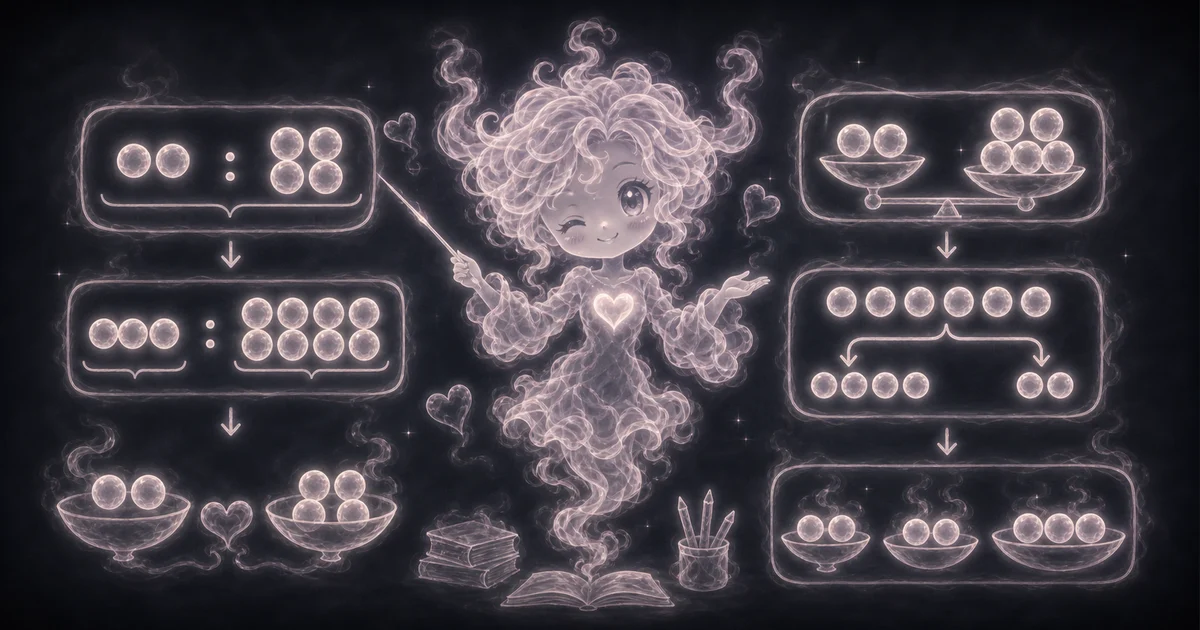
Split total mode adds the ratio parts, finds the value of one part, then multiplies each part. For 120 split by 2:3, there are 5 total parts. One part is 24. The two shares are 48 and 72.
This is useful when the final amount is already known: group shares, simple mixtures, classroom examples, budget splits, or ingredient planning.
Examples from the ratio calculator
2:3
20:35
48, 72
2:3
Mistakes to avoid
Keep the order the same. A 2:3 mix is not the same as a 3:2 mix. If blue paint is first and white paint is second, do not swap them halfway through the problem.
Keep units the same too. Do not simplify 2 feet : 18 inches until both sides use inches or both sides use feet. For pixel sizes, use the Aspect Ratio Calculatorwhen you are resizing width and height.
Where the math comes from
A ratio can be written as “a to b,” “a:b,” or as a fraction. OpenStax explains ratios as comparisons, and equivalent ratios as the same comparison scaled up or down. Khan Academy ratio lessons use the same idea with tables, rates, and proportional word problems.
The calculator does not decide whether your real-world setup is fair or safe. It only does the ratio math from the numbers you enter.
History, privacy, and copying
Recent ratio answers stay visible in the page while you work. That short history is kept only in the current browser tab. It is not sent to a server.
Copy answer copies the expression and result so you can paste it into notes, homework, a recipe plan, or a message.
Sources and limits
- OpenStax: Ratios and Proportionsfor ratio notation, proportions, and unit-rate context.
- OpenStax Prealgebra: Ratios and Ratefor simplifying ratios and clearing decimal parts.
- Khan Academy: Ratios and ratesfor equivalent-ratio and unit-rate practice.