2 cup to gram
- Input type
- volume
- Output type
- mass
- Density used
- 120 g/cup
This conversion uses the density you entered because volume-to-weight conversions depend on the ingredient.
Use this free cooking measurement converter to change teaspoons, tablespoons, fluid ounces, cups, pints, quarts, gallons, milliliters, liters, grams, kilograms, ounces, and pounds for recipe work.
2 cup to gram
This conversion uses the density you entered because volume-to-weight conversions depend on the ingredient.
Recent cooking conversions will appear here.
Cooking conversions stay local. Volume-to-weight conversions use the density you enter and are approximate.
Inputs and recent answers stay in this browser tab and are not sent to a server.
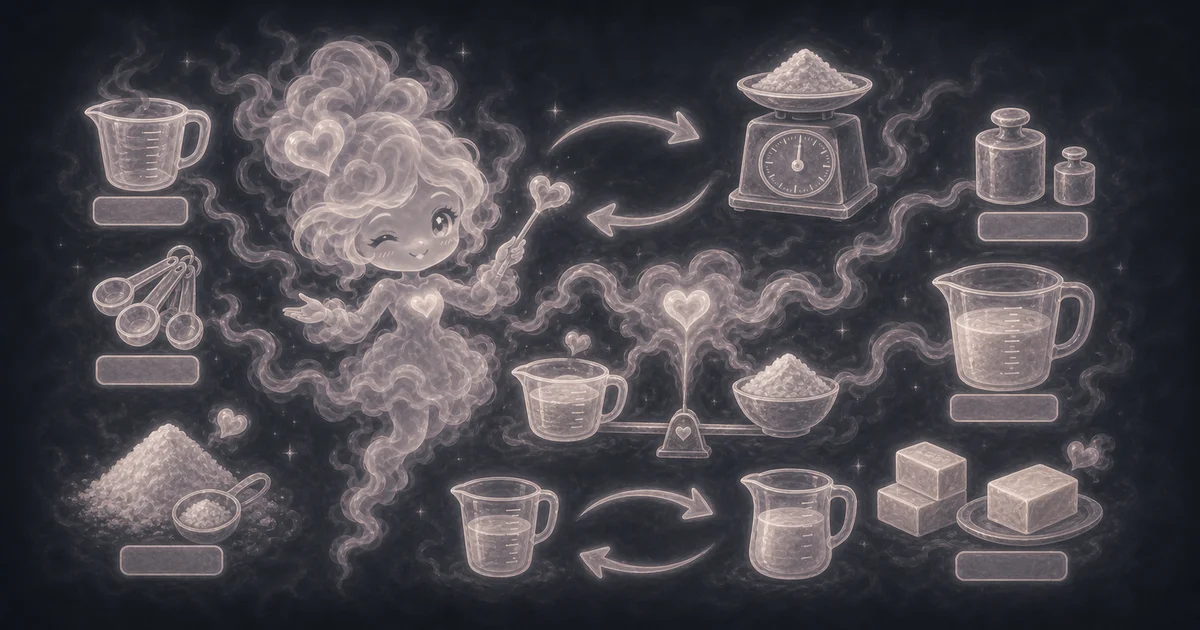
Convert cups of flour into grams with a density value.
Convert milliliters to cups for a recipe from another country.
Change ounces to grams without using a separate generic converter.
Explain why cups-to-grams depends on the ingredient.
Convert tablespoons to milliliters for small liquid or spice amounts.
Check whether a recipe unit conversion is fixed or density-based before scaling a batch.
240 g
About 2.1134 cups
About 113.3981 g
About 44.3603 mL
Need a slower walkthrough, a related converter, or the full library? These links keep you close to the task you started.
Plain-language answers about when to use the tool, what it does with your inputs, what to double-check, and how privacy works.
Use it when your task matches one of these common needs: Convert cups of flour into grams with a density value. Convert milliliters to cups for a recipe from another country. It works best when you already know the value, source unit, target unit, format, or mode the page asks for.
In plain language: Volume units convert through US cups: teaspoons / 48, tablespoons / 16, fluid ounces / 8, cups, pints x 2, quarts x 4, gallons x 16, milliliters / 236.5882365, and liters x 4.22675284. Mass units convert through grams: kilograms x 1000, ounces x 28.349523125, and pounds x 453.59237. When one side is volume and the other is weight, cups x density grams per cup gives grams; grams / density grams per cup gives cups before converting to the target unit. The examples on the page are there so you can compare your inputs with a filled-out example before copying the answer.
Amount: The number from the recipe, package, or measuring cup that you want to convert. From unit: The unit you already have, such as cups, tablespoons, milliliters, grams, ounces, or pounds. To unit: The unit you want the answer in. Density grams per cup: How many grams one level US cup of that ingredient weighs. It only changes answers when converting between volume and weight.
Read the output next to your original input. If the tool changes format, units, encoding, spacing, or capitalization, compare a small sample before copying the whole result into another app.
Volume-to-weight conversions are approximate because chopped, sifted, packed, grated, melted, and liquid ingredients can have different weights per cup. Use a kitchen scale or source-specific ingredient data when baking accuracy, nutrition labels, or selling food depend on the number. Also check the source unit, target unit, format, decimal places, and selected mode because small input changes can change the result.
It means the weight of one level US cup of a specific ingredient. A cup of flour may be around 120 g, while a cup of water is about 237 g, so the same volume can weigh very different amounts.
It matters when one unit is volume and the other is weight, such as cups to grams or ounces to tablespoons. It does not change fixed volume-to-volume conversions like cups to tablespoons, or fixed weight-to-weight conversions like ounces to grams.
A cup measures space, while grams measure weight. Flour, sugar, oats, chopped nuts, honey, oil, and cocoa can all weigh different amounts per cup, and scooping or packing changes the real amount.
Yes. The converter treats 1 US cup as 236.5882365 milliliters, so 500 mL is about 2.1134 US cups.
Yes. The converter uses US cooking units, where 1 tablespoon is 1/16 cup, so 3 tablespoons is about 44.3603 mL.
Use it as a helpful estimate, then prefer a kitchen scale for baking when accuracy matters. How an ingredient is scooped, sifted, chopped, or packed can change the true weight.
No. This converter is general. Use the Butter Converter when you specifically need sticks, cups, tablespoons, grams, ounces, and pounds of butter with common butter equivalents.
No. The tool runs in your browser tab. Your recent answers stay only on the page while you use it, and they are not sent to a server.