1000 W for 3 h/day
- Energy
- 90 kWh
- Days
- 30
- Rate
- $0.16 per kWh
Estimate appliance electricity use from watts, hours per day, days, and price per kWh, then see kWh and cost examples.
1000 W for 3 h/day
Recent electricity estimates will appear here.
Electricity cost math stays local and uses the rate you enter.
Inputs and recent answers stay in this browser tab and are not sent to a server.
Estimate appliance energy use.
Compare a heater, AC, computer, or light over time.
Turn watts and usage time into kWh.
Multiply kWh by your local rate.
Check whether a device is worth measuring with a plug-in power meter.
Compare monthly and yearly energy-cost scenarios.
180 kWh, about $28.80
18.25 kWh, about $2.92
40.5 kWh, about $7.29
216 kWh, about $34.56
Need a slower walkthrough, a related calculator, or the full library? These links keep you close to the task you started.
Plain-language answers about when to use the tool, what it does with your inputs, what to double-check, and how privacy works.
Use it when your task matches one of these common needs: Estimate appliance energy use. Compare a heater, AC, computer, or light over time. It works best when you already know the measurements, amounts, units, or options the page asks for.
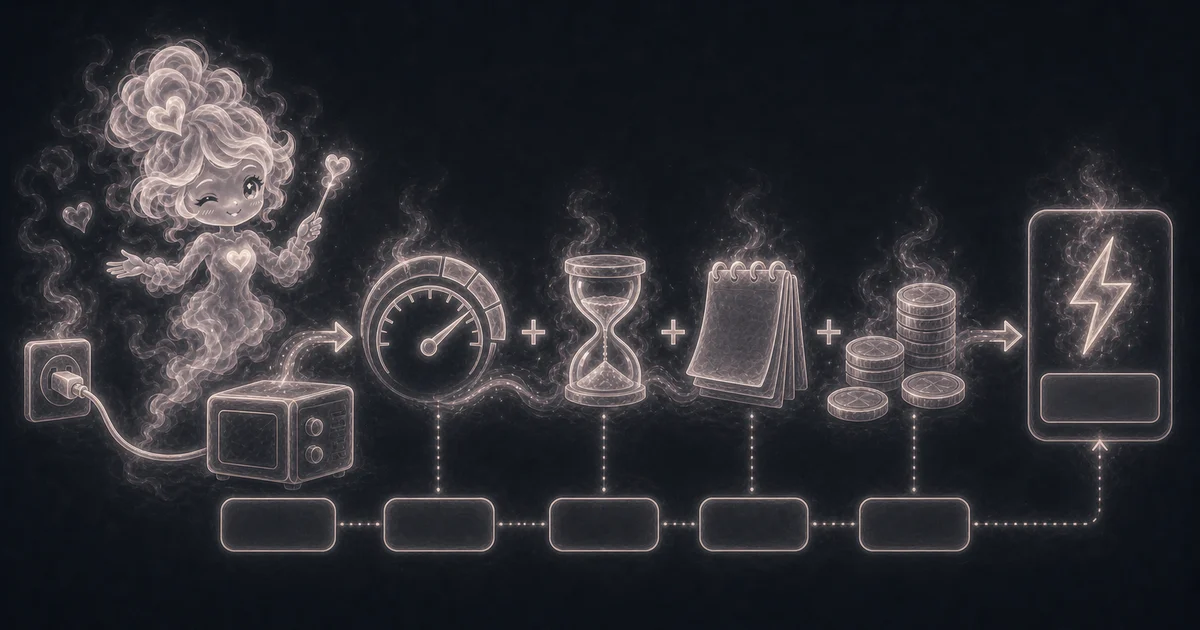
In plain language: The calculator divides watts by 1,000 to get kilowatts, then uses kWh = (watts / 1,000) x hours per day x days. Estimated cost = kWh x rate per kWh. The examples on the page are there so you can compare your inputs with a worked example before copying the answer.
Watts: the device power draw from a label, meter, or reasonable estimate. One kilowatt is 1,000 watts. Hours per day: how long the device actually runs on an average day, not always how long it is plugged in. Days: how many days are in the estimate window, such as 30 for a rough month or 365 for a year. Rate per kWh: your electricity price for one kilowatt-hour before taxes, fixed charges, or other bill fees.
Read the headline answer, then check the smaller lines beside it. For everyday tools, those lines usually show the distance, time, cost, units, or setting that made the answer change.
This is an appliance-level estimate from the numbers you enter. Real bills can include taxes, fees, tiered rates, demand charges, standby use, cycling devices, seasonal changes, and variable power draw. Also check the unit, scale, mode, and result limit because small input changes can change the answer.
A kilowatt-hour is energy use. Running a 1,000 watt device for 1 hour uses 1 kWh. Running a 100 watt device for 10 hours also uses 1 kWh.
Use 30 or 31 days, enter the device watts, estimate average hours per day, and enter your rate per kWh. For example, 1,500 W for 4 hours a day over 30 days is 180 kWh, which costs $28.80 at $0.16/kWh.
The calculator only estimates one device from watts, time, and rate. Your full bill can include fixed fees, taxes, tiered pricing, demand charges, fuel adjustments, standby loads, and other devices.
Use average watts or average running time when you have it. Refrigerators, air conditioners, heaters, pumps, and dehumidifiers can cycle, so nameplate watts can overstate or understate real energy use.
No. kW is power, or how fast energy is being used. kWh is energy over time, which is why bills usually charge by kilowatt-hour.
Yes, if the device uses power while idle and you include that wattage and time. A plug-in power meter can help when the standby draw is small but runs all day.
No. The calculator runs in your browser tab. Your recent answers stay only on the page while you use it, and they are not sent to a server.