Quick start
- Enter the amount from the recipe, label, or measuring tool.
- Choose the starting unit, such as cups, tablespoons, milliliters, grams, ounces, or pounds.
- Choose the unit you want as the answer.
- Enter grams per cup only when converting between volume and weight.
Best uses
Start here if one of these sounds like your job. The examples below show which inputs matter most.
- Convert cups of flour into grams with a density value.
- Convert milliliters to cups for a recipe from another country.
- Change ounces to grams without using a separate generic converter.
- Explain why cups-to-grams depends on the ingredient.
What this converter helps with
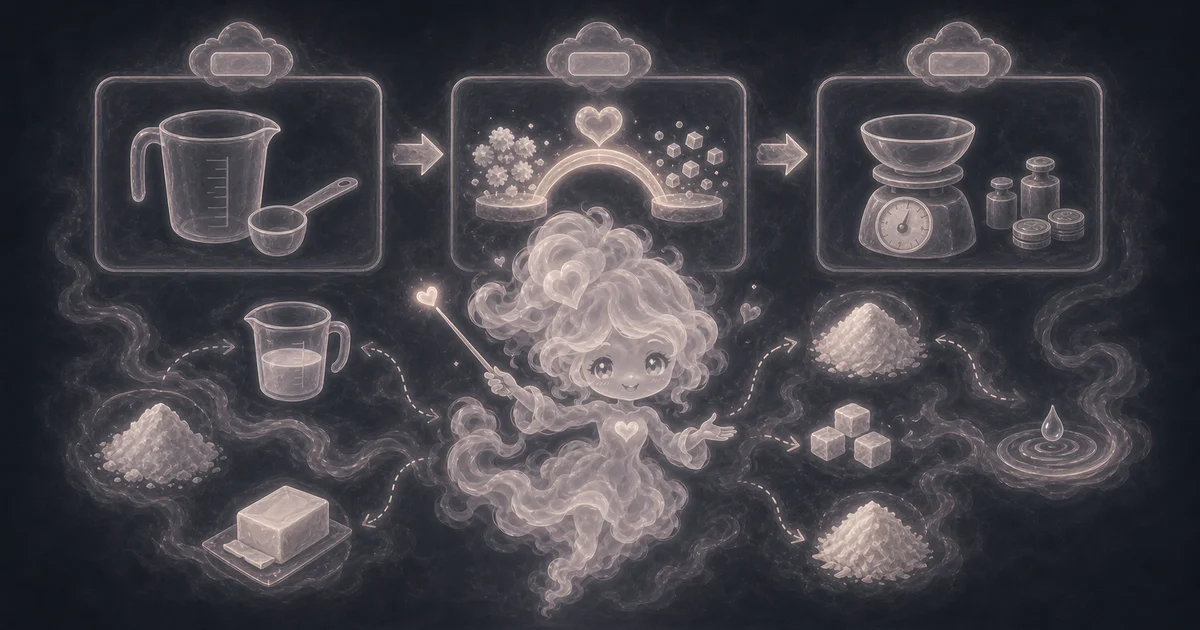
The Cooking Measurement Converter handles common recipe units for cooking and baking. It uses fixed factors when both units measure volume or both units measure weight, and it uses ingredient density when a conversion crosses between volume and weight.
Match each input label on the converter to the amount, from unit, to unit, and density grams per cup fields. Leave the density alone for volume-to-volume or weight-to-weight conversions, and change it only when one side is volume and the other side is weight..
The logic in plain language
In plain language: Volume units convert through US cups: teaspoons / 48, tablespoons / 16, fluid ounces / 8, cups, pints x 2, quarts x 4, gallons x 16, milliliters / 236.5882365, and liters x 4.22675284. Mass units convert through grams: kilograms x 1000, ounces x 28.349523125, and pounds x 453.59237. When one side is volume and the other is weight, cups x density grams per cup gives grams; grams / density grams per cup gives cups before converting to the target unit. The examples on the page are there so you can compare your inputs with a filled-out example before copying the answer.
For volume-only conversions, the guide routes through US cups: 1 cup is 16 tablespoons, 48 teaspoons, 8 fluid ounces, or 236.5882365 mL. For weight-only conversions, it routes through grams: 1 ounce is 28.349523125 g and 1 pound is 453.59237 g. For cups-to-grams style answers, it first turns the volume into cups, then multiplies by density grams per cup.
How to read the answer
Read the converted amount first, then check whether the answer used fixed unit factors or a density estimate. If density was used, treat the number as a recipe estimate instead of a lab measurement.
- The main answer is the converted amount in the new unit.
- Input type and output type show whether the conversion used volume, weight, or both.
- Density used matters only when cups, tablespoons, fluid ounces, mL, or liters are converted to grams, ounces, pounds, or the reverse.
- Fixed volume conversions such as tablespoons to mL do not change when density changes.
- Fixed weight conversions such as ounces to grams do not change when density changes.
Common mistakes to avoid
If the answer looks strange, the most likely cause is a small input mismatch: the wrong text, mode, format, line break, privacy choice, or platform rule.
- Do not use one cups-to-grams number for every ingredient.
- Do not treat scooped, packed, sifted, chopped, and liquid ingredients as identical.
- Do not confuse fluid ounces, which measure volume, with ounces by weight.
- Do not copy a density value without checking whether the ingredient was packed, sifted, melted, chopped, or level.
- Use a kitchen scale when exact baking measurements matter.
Example: 2 cups of flour to grams
If your flour estimate is 120 grams per US cup, 2 cups becomes 2 x 120 = 240 grams. The converter returns 240 g because this is a volume-to-weight conversion.
If you change the density to 130 grams per cup, the same 2 cups becomes 260 grams. That difference is the point: cups measure space, while grams measure weight, so the ingredient and measuring style matter.
Example: 500 mL to cups and 3 tablespoons to mL
A 500 mL liquid amount is about 2.1134 US cups because the converter divides by 236.5882365 mL per cup. Density does not matter because both sides are volume units.
Three US tablespoons is 3/16 of a cup, which is about 44.3603 mL. This is useful for small liquid, extract, spice, or sauce amounts when a recipe mixes spoon and metric units.
How to choose density grams per cup
Use the most specific density you can find for the ingredient and preparation style. A level cup of flour, a packed cup of brown sugar, a chopped cup of nuts, and a cup of water should not share one number.
A package label, a trusted ingredient database, or your own weighed cup can give a better estimate. If the recipe is important, write down the density you used so you can repeat the result next time.
When a kitchen scale is safer
Use the converter for planning, shopping, quick recipe translation, and rough batch checks. Use a scale when the recipe depends on texture, hydration, nutrition labels, selling food, or repeating the same bake accurately.
The converter can make a clear estimate, but it cannot know whether your cup was fluffed, scooped, sifted, packed, rounded, melted, or chopped. That measuring detail is often bigger than the calculator rounding.
Research and references
These references help check the tool logic, format choices, platform limits, or safety notes.
Worked examples for Cooking Measurement Converter
240 g
About 2.1134 cups
About 113.3981 g
About 44.3603 mL
FAQ in plain language
When should I use the Cooking Measurement Converter?
Use it when your task matches one of these common needs: Convert cups of flour into grams with a density value. Convert milliliters to cups for a recipe from another country. It works best when you already know the value, source unit, target unit, format, or mode the page asks for.
What is the Cooking Measurement Converter doing with my inputs?
In plain language: Volume units convert through US cups: teaspoons / 48, tablespoons / 16, fluid ounces / 8, cups, pints x 2, quarts x 4, gallons x 16, milliliters / 236.5882365, and liters x 4.22675284. Mass units convert through grams: kilograms x 1000, ounces x 28.349523125, and pounds x 453.59237. When one side is volume and the other is weight, cups x density grams per cup gives grams; grams / density grams per cup gives cups before converting to the target unit. The examples on the page are there so you can compare your inputs with a filled-out example before copying the answer.
What do the main Cooking Measurement Converter inputs mean?
Amount: The number from the recipe, package, or measuring cup that you want to convert. From unit: The unit you already have, such as cups, tablespoons, milliliters, grams, ounces, or pounds. To unit: The unit you want the answer in. Density grams per cup: How many grams one level US cup of that ingredient weighs. It only changes answers when converting between volume and weight.
How should I read the Cooking Measurement Converter answer?
Read the output next to your original input. If the tool changes format, units, encoding, spacing, or capitalization, compare a small sample before copying the whole result into another app.
What should I double-check before trusting the answer?
Volume-to-weight conversions are approximate because chopped, sifted, packed, grated, melted, and liquid ingredients can have different weights per cup. Use a kitchen scale or source-specific ingredient data when baking accuracy, nutrition labels, or selling food depend on the number. Also check the source unit, target unit, format, decimal places, and selected mode because small input changes can change the result.
What does density grams per cup mean?
It means the weight of one level US cup of a specific ingredient. A cup of flour may be around 120 g, while a cup of water is about 237 g, so the same volume can weigh very different amounts.
When does the density field matter?
It matters when one unit is volume and the other is weight, such as cups to grams or ounces to tablespoons. It does not change fixed volume-to-volume conversions like cups to tablespoons, or fixed weight-to-weight conversions like ounces to grams.
Related tools
- Recipe ScalerScale one recipe ingredient from original servings to the servings you want to make.
- Butter ConverterConvert butter between sticks, tablespoons, cups, ounces, grams, teaspoons, and pounds.
- Ingredient Cost CalculatorEstimate how much one recipe ingredient costs from package price and amount used.
- Baking Pan Conversion CalculatorCompare rectangular baking pan areas and estimate how much to scale a recipe.
Keep exploring
If this guide is close but not exact, these links keep you near the same kind of problem.
- ConvertersBrowse the full category for related tools that help with the same job.
- All free toolsSearch the complete Access Free Tools library by task, category, or tool name.
- All tool and utility guidesFind more plain-language examples, logic notes, mistakes, and result explanations.
- Free tool resourcesStart here when you are not sure which tool page fits.
Privacy and copying results
Recent answers stay visible only while you work in the current browser tab. They are not sent to a server.
Use Copy answer when you want to save the inputs and result in notes, homework, a message, or a project list. Check the units, labels, and limits before copying.