Quick start
- Enter the deck length and width in feet for the rectangular surface you want to cover.
- Enter the purchased board length in feet. Use the stock length you are actually comparing, such as 12 ft, 16 ft, or 20 ft boards.
- Enter the actual board face width in inches. A nominal 5/4 x 6 board is often about 5.5 inches wide, but check the product label or measure the board.
- Enter joist spacing in inches. This drives the fastener-row and screw estimate, not the board count.
- Enter a waste percent for cuts, damaged boards, starter pieces, and layout changes. Add optional price per board only if you want a board-only cost line.
Best uses
Start here if one of these sounds like your job. The examples below show which inputs matter most.
- Estimate deck boards for a simple rectangular deck.
- Compare 12-foot, 16-foot, and 20-foot board layouts.
- Plan a rough deck screw count from joist spacing.
- Add a waste allowance before pricing boards.
What this calculator is solving
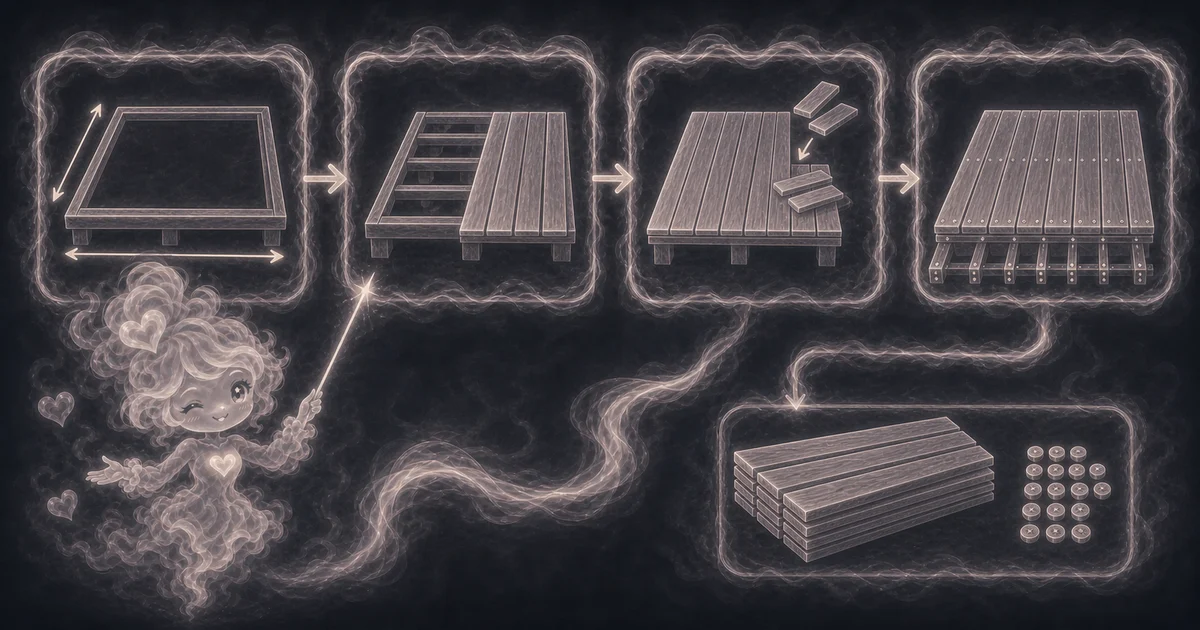
The Deck Board Calculator helps you plan the visible decking surface for a simple rectangular deck. It turns deck dimensions, purchased board length, actual board width, waste percent, and joist spacing into whole boards, fastener rows, screw count, and optional board-only cost.
Match each input label on the calculator to deck length, deck width, board length, actual board width, joist spacing, waste percent, and optional price per board.
The formula in plain language
In plain language: The calculator uses deck area = deck length x deck width, adjusted area = deck area x (1 + waste percent / 100), board coverage = board length x actual board width / 12, boards needed = ceiling(adjusted area / board coverage), fastener rows = floor(deck length x 12 / joist spacing) + 1, and screws = boards needed x fastener rows x 2. The examples on the page are there so you can compare your inputs with a 16 x 12 deck example before copying the answer.
The calculator uses deck area = length x width, adjusted area = deck area x (1 + waste percent / 100), board coverage = board length x actual board width / 12, boards needed = ceiling(adjusted area / board coverage), fastener rows = floor(deck length x 12 / joist spacing) + 1, and screws = boards needed x fastener rows x 2.
How to read the answer
Read boards needed first because that is the main buying count. Then check fastener rows and screw estimate so you know whether the joist spacing assumption is close to your deck plan.
- Boards needed is the rounded-up count after waste is added to the deck area.
- Adjusted deck area shows the surface area after waste. This is useful when you want to see how much cushion the waste percent added.
- Fastener rows comes from deck length and joist spacing. Tighter joist spacing usually means more rows and more screws.
- Deck screws estimate uses two screws for each board-and-joist crossing. Hidden fasteners and clips may not match this screw count.
- Estimated board cost is boards needed times price per board. It is not a full deck quote.
Common mistakes to avoid
Most bad deck-board estimates come from using nominal board width, forgetting waste, treating a picture-frame deck like a plain rectangle, or assuming the screw count also covers clips, borders, stairs, and blocking.
- Do not use nominal board width if the actual face width is different.
- Do not treat board gaps, picture-frame borders, breaker boards, stair boards, fascia, or diagonal layouts as automatically included.
- Do not set waste to zero unless the layout is unusually simple and you are comfortable handling cut mistakes separately.
- Do not treat the screw estimate as a hidden-fastener clip schedule. Follow the fastener manufacturer and deck-board instructions.
- Do not use the board-only cost as a contractor quote. Framing, railing, stairs, hardware, delivery, labor, permits, and code changes are separate.
Quick 16 x 12 deck example
Say the deck is 16 ft by 12 ft. The surface area is 192 square feet. With 10% waste, the calculator plans for 211.2 square feet of decking.
A 16 ft board with 5.5 inches of actual face width covers about 7.333 square feet. 211.2 divided by 7.333 rounds up to 29 boards. With 16 inch joist spacing, the example shows 13 fastener rows and 754 deck screws. At $18 per board, the board-only cost is $522.
Actual board width and board gaps
Actual board width is the exposed face width you enter into the calculator. Nominal names are not always exact sizes, so a small width mismatch can change the count on a larger deck.
The calculator does not ask for a separate gap field. Board gaps still matter for installation, drainage, expansion, and edge planning, so check the deck-board or fastener instructions before buying.
Joist spacing, rows, and screws
Joist spacing tells the calculator how many fastening rows run across the deck length. If the joists are 16 inches on center, a 16 ft length gives 13 rows because the calculator counts the starting row and the ending row.
The screw estimate is simple on purpose: two screws at each board-and-joist crossing. Hidden fasteners, clips, plugs, borders, blocking, and stairs can need a different count.
Diagonal boards and picture frames
A diagonal deck can look great, but it usually creates more angled cuts and more waste than a straight layout. Use a higher waste percent or a detailed material takeoff if the board direction is not simple.
Picture-frame borders, breaker boards, fascia, and stair treads should be counted as their own pieces. This tool estimates the main rectangular field, then leaves those design details for your plan or installer.
From board count to a fuller deck budget
Deck boards are only one part of a deck project. Joists, beams, posts, railings, stairs, hardware, concrete, delivery, tools, permits, and labor can move the real budget much more than one extra board.
After you have a board count, use the Deck Cost Calculator if you want a rough project budget with decking surface cost, railing, stairs, and waste in one place.
Research and references
These references help check the measurements, units, limits, or safety notes used in this guide.
Worked examples for Deck Board Calculator
29 boards, 13 rows, 754 screws, $522
17 boards and 272 screws
32 boards, 16 rows, 1,024 screws, $1,024
39 boards and 1,326 screws
FAQ in plain language
When should I use the Deck Board Calculator?
Use it when your task matches one of these common needs: Estimate deck boards for a simple rectangular deck. Compare 12-foot, 16-foot, and 20-foot board layouts. It works best when you already know deck length, deck width, board length, actual board width, joist spacing, waste percent, and optional price per board.
What is the Deck Board Calculator doing with my inputs?
In plain language: The calculator uses deck area = deck length x deck width, adjusted area = deck area x (1 + waste percent / 100), board coverage = board length x actual board width / 12, boards needed = ceiling(adjusted area / board coverage), fastener rows = floor(deck length x 12 / joist spacing) + 1, and screws = boards needed x fastener rows x 2. The examples on the page are there so you can compare your inputs with a 16 x 12 deck example before copying the answer.
What do the main Deck Board Calculator inputs mean?
Deck length and width: the rectangular deck surface area before waste is added. Board length and width: the coverage of one deck board. Use actual face width, not only the nominal board name. Joist spacing: the on-center distance between joists, used to estimate fastener rows. Waste percent: extra boards for cuts, starter pieces, layout changes, and damaged boards. Price per board: optional cost for one board, used only for the rough board-cost line.
How should I read the Deck Board Calculator answer?
Read the headline estimate first, then check the material, waste, coverage, and unit lines. For project tools, the supporting lines are often the difference between a rough idea and a list you can actually shop from.
What should I double-check before trusting the answer?
This is a straight rectangular deck-surface estimate, not a full deck plan. Board gaps, diagonal layouts, picture frames, breaker boards, stairs, fascia, borders, hidden fastener clips, blocking, stock lengths, manufacturer rules, and local code can change the real material list. Also check the board gap, picture-frame borders, breaker boards, stair boards, fascia, hidden fastener system, stock lengths, and local building rules before buying.
How many deck boards do I need for a 16 x 12 deck?
With 16 ft boards, 5.5 in actual board width, 16 in joist spacing, and 10% waste, the calculator estimates 29 boards. The same example shows 13 fastener rows, 754 deck screws, and $522 if each board costs $18.
Why does the Deck Board Calculator ask for actual board width?
Deck boards are often sold with a nominal size that is not the exact face width. The calculator needs the width that actually covers the deck surface because a small width difference can change the board count on a large deck.
Related tools
- Deck Cost CalculatorEstimate rough deck project cost from deck size, decking price, railing, stairs, and waste.
- Stair CalculatorEstimate risers, treads, stair run, and angle from total rise and tread depth.
- Plywood CalculatorEstimate plywood sheet count, coverage, waste, and optional cost.
Keep exploring
If this guide is close but not exact, these links keep you near the same kind of problem.
- Home & ProjectsBrowse the full category for related tools that help with the same job.
- All free toolsSearch the complete Access Free Tools library by task, category, or tool name.
- All calculator and utility guidesFind more plain-language examples, formulas, mistakes, and result explanations.
- Free calculator resourcesStart here when you are not sure which calculator page fits.
Privacy and copying results
Recent answers stay visible only while you work in the current browser tab. They are not sent to a server.
Use Copy answer when you want to save the inputs and result in notes, homework, a message, or a project list. Check the units, labels, and limits before copying.