Quick start
- Enter pavement length and width in feet.
- Enter compacted asphalt depth in inches, not the loose depth before rolling.
- Enter tons per cubic yard from the supplier, or use 2 only as a rough hot-mix planning number.
Best uses
Use this guide for driveway sections, parking pads, patch planning, and checking whether a paving quote feels close before you ask for a site measurement.
- Estimate asphalt tons for a simple driveway section.
- Convert compacted depth into cubic yards.
- Compare 2-inch, 3-inch, and 4-inch depth assumptions.
- Use supplier density before talking with a paving contractor.
What this calculator is solving
The Asphalt Calculator estimates rough hot-mix asphalt quantity from pavement dimensions and compacted depth. It is best for early planning before a paving contractor measures the job.
Match each input label on the calculator to the paved length, paved width, compacted depth, tons per cubic yard, and waste percent.
The formula in plain language
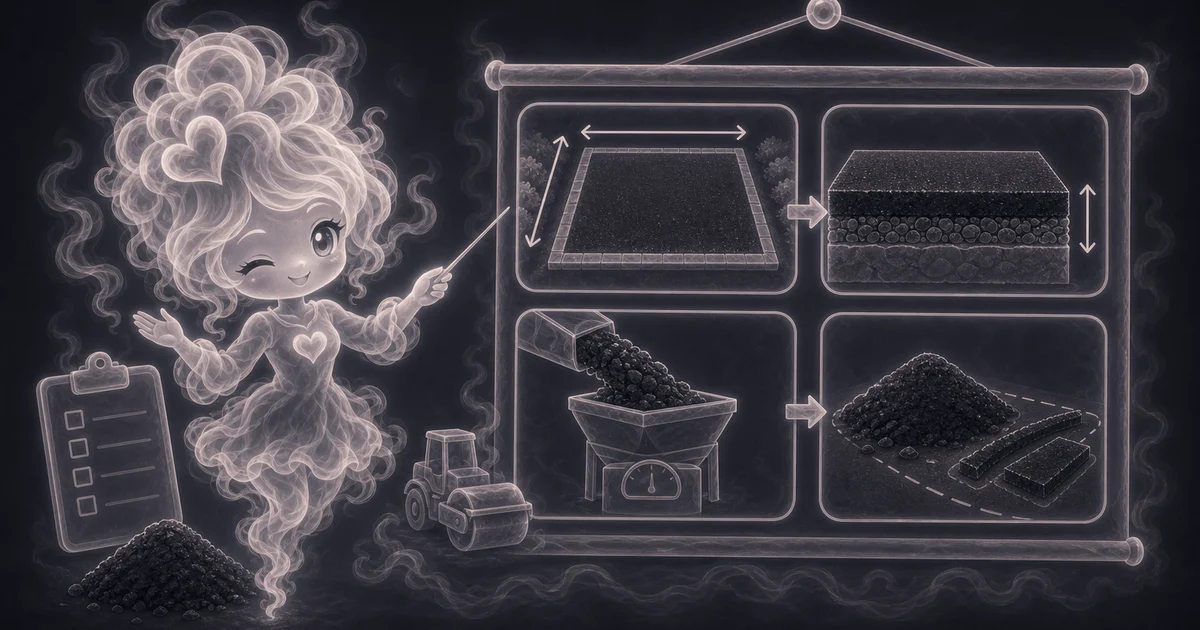
In plain language: Cubic feet = length x width x compacted depth in feet. Cubic yards = cubic feet / 27. Tons = cubic yards x tons per cubic yard. The examples on the page are there so you can compare your inputs with a driveway section example before copying the answer.
The calculator turns inches into feet, finds cubic feet, adds waste, converts to cubic yards, then multiplies by tons per cubic yard.
How to read the answer
Read tons as the rough ordering number. Read cubic yards and cubic feet as the volume behind that number, so you can spot a bad density assumption before calling a supplier.
- A 30 ft by 12 ft section at 3 inches compacted depth is 90 cubic feet before waste.
- With 5 percent waste, that becomes 94.5 cubic feet, or 3.5 cubic yards.
- At 2 tons per cubic yard, the estimate is 7 tons.
Common mistakes to avoid
The big mistake is mixing loose depth, compacted depth, and supplier density in one estimate. Asphalt Institute notes that in-place asphalt mixture commonly weighs about 142 to 148 pounds per cubic foot, so the default 2 tons per cubic yard is only a planning shortcut.
- Do not use this as a paving specification or contractor measurement.
- Do not ignore base condition, lift thickness, compaction, mix type, and plant minimums.
- Ask a paving professional or supplier for project-specific density and ordering guidance.
- Do not use loose asphalt depth unless your supplier specifically tells you how to convert it.
Example: 30 ft by 12 ft driveway section
A 30 ft by 12 ft section has 360 square feet of area. At 3 inches compacted depth, that is 90 cubic feet before waste.
Add 5 percent waste and the volume becomes 94.5 cubic feet. Divide by 27 and you get 3.5 cubic yards. At 2 tons per cubic yard, the result is 7 tons.
Why compacted depth matters
The calculator is asking for the finished depth after rolling. Loose material can shrink during compaction, so loose depth and compacted depth are not the same thing.
Compaction quality also affects pavement life. Poor density can lead to problems like rutting, raveling, and moisture damage, so a real paving job needs more than calculator math.
Why the density box is not a tiny detail
Asphalt Institute says in-place asphalt mixture commonly weighs about 142 to 148 pounds per cubic foot. That works out close to 2 tons per cubic yard.
Your local mix, recycled material, temperature, and supplier practice can still change the number. Use the supplier density when you have it.
Research and references
These references explain asphalt quantity, density, compaction, and why a real paving job needs project-specific measurements.
Worked examples for Asphalt Calculator
7 tons
9.6 tons
5.19 tons
FAQ in plain language
When should I use the Asphalt Calculator?
Use it when your task matches one of these common needs: Estimate asphalt tons for a simple driveway section. Convert compacted depth into cubic yards. It works best when you already know the paved length, paved width, compacted depth, tons per cubic yard, and waste percent.
What is the Asphalt Calculator doing with my inputs?
In plain language: Cubic feet = length x width x compacted depth in feet. Cubic yards = cubic feet / 27. Tons = cubic yards x tons per cubic yard. The examples on the page are there so you can compare your inputs with a driveway section example before copying the answer.
What do the main Asphalt Calculator inputs mean?
Length and width: the paved rectangle in feet, measured only for the section you want to estimate. Compacted depth: the finished asphalt thickness after compaction, not loose material depth. Tons per cubic yard: the density assumption used to convert volume into asphalt tonnage. About 2 is a common planning shortcut for hot mix. Waste percent: extra material for edges, compaction differences, and small measurement errors. Cubic yards: the volume before it is converted into tons. Estimated tons: the rough material weight to discuss with a supplier or paving contractor.
How should I read the Asphalt Calculator answer?
Read the headline estimate first, then check the material, waste, coverage, and unit lines. For project tools, the supporting lines are often the difference between a rough idea and a list you can actually shop from.
What should I double-check before trusting the answer?
Asphalt Institute gives 142 to 148 lb/ft3 as a common in-place asphalt mixture range. Local mix, compaction target, lift thickness, base, plant minimums, and professional measurement can change the order. Check that the depth is compacted depth, the density came from a supplier when possible, and the area matches the part being paved. A real paving quote also needs base condition, drainage, lift thickness, and site access.
Why does the Asphalt Calculator use compacted depth?
Because the finished pavement thickness is what matters. Loose hot mix can change depth after rolling, so loose depth and compacted depth should not be treated as the same number.
Is 2 tons per cubic yard always right for asphalt?
No. It is a useful planning shortcut because 148 lb/ft3 is about 2 tons per cubic yard. Ask your asphalt supplier for the density they want you to use.
Related tools
- Gravel CalculatorEstimate gravel cubic yards and tons from length, width, depth, and density.
- Cubic Yard CalculatorConvert length, width, depth, and waste into cubic feet and cubic yards.
- Area CalculatorCalculate flat-shape area for rectangles, triangles, circles, trapezoids, and parallelograms.
Keep exploring
If this guide is close but not exact, these links keep you near the same kind of problem.
- Home & ProjectsBrowse the full category for related tools that help with the same job.
- All free toolsSearch the complete Access Free Tools library by task, category, or tool name.
- All calculator and utility guidesFind more plain-language examples, formulas, mistakes, and result explanations.
- Free calculator resourcesStart here when you are not sure which calculator page fits.
Privacy and copying results
Recent answers stay visible only while you work in the current browser tab. They are not sent to a server.
Use Copy answer when you want to save the inputs and result in notes, homework, a message, or a project list. Check the units, labels, and limits before copying.